
Cozy Kitchen Lighting Ideas That Change Everything After Dark
Some visuals may be AI-generated when helpful. All opinions are my own.
Kitchen lighting is the element of kitchen design that most people get wrong in the most invisible way — they light the kitchen for function and then wonder why it never feels warm. I spent years with a kitchen that was well-lit and cold because every surface was evenly illuminated and evenness, it turns out, is the enemy of warmth. The kitchens I keep coming back to are lit unevenly, specifically, in layers — and that layering is what makes them feel like somewhere you want to stay rather than somewhere you pass through.
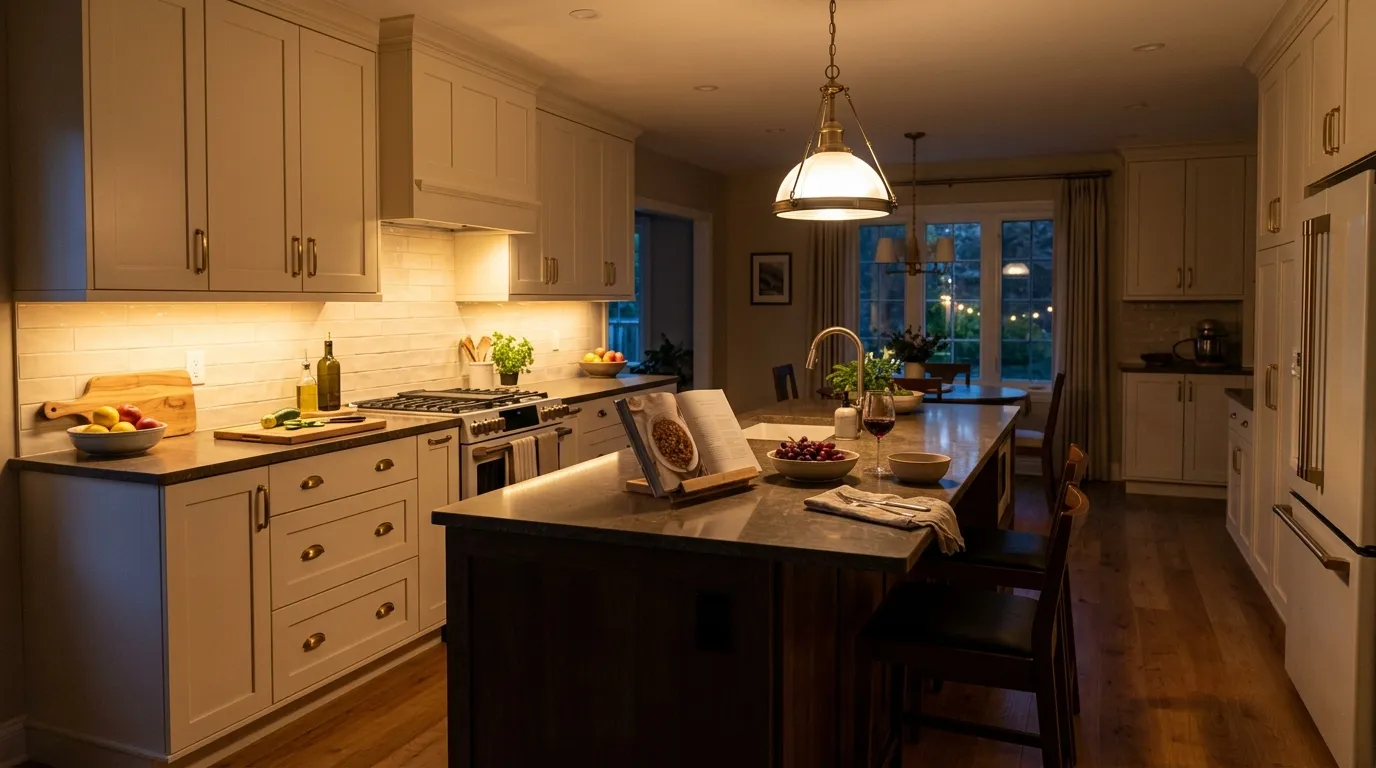
A large statement pendant in aged brass above a kitchen island is the single lighting fixture that does the most work in a kitchen because it provides the focused task light the island needs while simultaneously anchoring the room visually. The aged brass is warm in both color and association — the specific patina of brass that has been handled and aged is warm in a way that new polished brass or chrome is not — and as an object the pendant is beautiful whether the light is on or off.

Three matching pendants in a row above a long island create a rhythm — three pools of warm light, three objects in space — that gives the kitchen a specific visual order that a single pendant cannot provide. The smoked glass diffusion producing amber light means the pools are soft rather than sharp, which keeps the kitchen feeling warm rather than theatrical. The gentle shadow between the pools is the darkness that makes the light meaningful.

Lighting inside glass-front cabinets that illuminates the glassware and ceramics within is the kitchen lighting approach that turns storage into display without moving anything. Glassware lit from within catches the light in a way that glassware in an unlit cabinet simply doesn’t and the soft internal glow contributes to the overall kitchen warmth in a way that adds atmosphere without being visible as a specific light source. The light appears to come from the objects themselves.

A vintage filament bulb pendant above the kitchen sink is the lighting choice that makes dishwashing beautiful which is the most counterintuitive statement in interior design and also completely true. The amber filament glow is warm enough and directed enough that standing at the sink in the evening becomes the kitchen’s most warmly lit spot, and that specific quality of warm light at the sink in the evening is one of the most undervalued domestic experiences available.

Backlit open shelving where the objects are silhouetted against the warm light behind them is the kitchen lighting concept that turns shelving into a focal wall. The objects become more beautiful in silhouette than in full illumination because their forms are isolated and the light behind them gives each one a presence that overhead lighting distributes evenly and therefore equalizes. This is kitchen lighting as art direction.

Recessed overhead lighting dimmed to ambient fill combined with pendant task lighting is the kitchen lighting approach that most professional lighting designers recommend and most homeowners don’t install because it requires thinking about two separate circuits and two separate dimmer switches. When both are present and the overhead is kept low while the pendants provide the character, the kitchen has the layered warmth that makes it feel professionally lit without feeling institutional.

A collection of mismatched vintage pendants above a kitchen island is the lighting approach that treats the fixtures as collected objects rather than chosen accessories, and that quality of accumulated rather than curated is what gives the kitchen warmth that matched sets sometimes lack. Each pendant throws light slightly differently and the combination of those different qualities below the island creates a warm and multidirectional light that is more interesting than a single source.

LED strips under the island overhang that make the island appear to float are the kitchen lighting detail that works at floor level — the warm glow reaching down and illuminating the floor beneath creates a pool of warmth at foot level that adds to the layered lighting from above. The floating effect is beautiful as a visual phenomenon and the warmth at floor level contributes to the overall kitchen atmosphere in a way that no above-counter lighting can provide.

A large industrial pendant directing all its light downward onto the kitchen table makes the table the warmest and most specifically lit place in the kitchen, which changes the table’s role in the room — it becomes the destination rather than the furniture. The warm pool of table light surrounded by softer ambient kitchen light creates the quality of light that restaurants spend considerable effort and money trying to achieve, and in a kitchen with the right pendant above the right table, it happens naturally.

Morning light in a kitchen with an east-facing window is the kitchen lighting condition that no electric fixture can replicate and no design decision can substitute for — the specific quality of early morning sun entering a kitchen, warming the surfaces it touches, creating shadows at angles that only happen for an hour in the morning, is the lighting that makes people want to be in the kitchen early. Kitchen orientation is a lighting decision even though it’s made at the architectural rather than the interior design stage.

A kitchen in candlelight only is the most beautiful version of kitchen lighting available and the most impractical, and that combination of beauty and impracticality is why it matters as an idea even when candles aren’t the primary source. The moving warmth of multiple candle flames across kitchen surfaces — the windowsill, the table, the walls — is the lighting condition that makes kitchens feel genuinely alive rather than illuminated. Cooking by candlelight in a kitchen that allows it is an experience worth seeking once.

Toe kick lighting at the base of kitchen cabinets is the kitchen lighting detail that works entirely at floor level and makes the kitchen visually lighter at its base — the warm glow beneath the cabinets lifts them from the floor and contributes the lowest layer of a properly layered kitchen lighting scheme. At night with other lights dimmed, the toe kick glow alone gives the kitchen a warm and slightly surreal quality, as if the cabinets are generating their own light from below.

Kitchen lighting is the most transformative and most underinvested element of kitchen design because it’s invisible when it’s right. Nobody stands in a warmly lit kitchen and thinks about the lighting. They think about staying. They think about cooking something. They open a bottle of malt and don’t leave. That’s the lighting working. The goal is not a well-lit kitchen. The goal is a kitchen where the light makes you want to be there and you can’t immediately explain why.


