
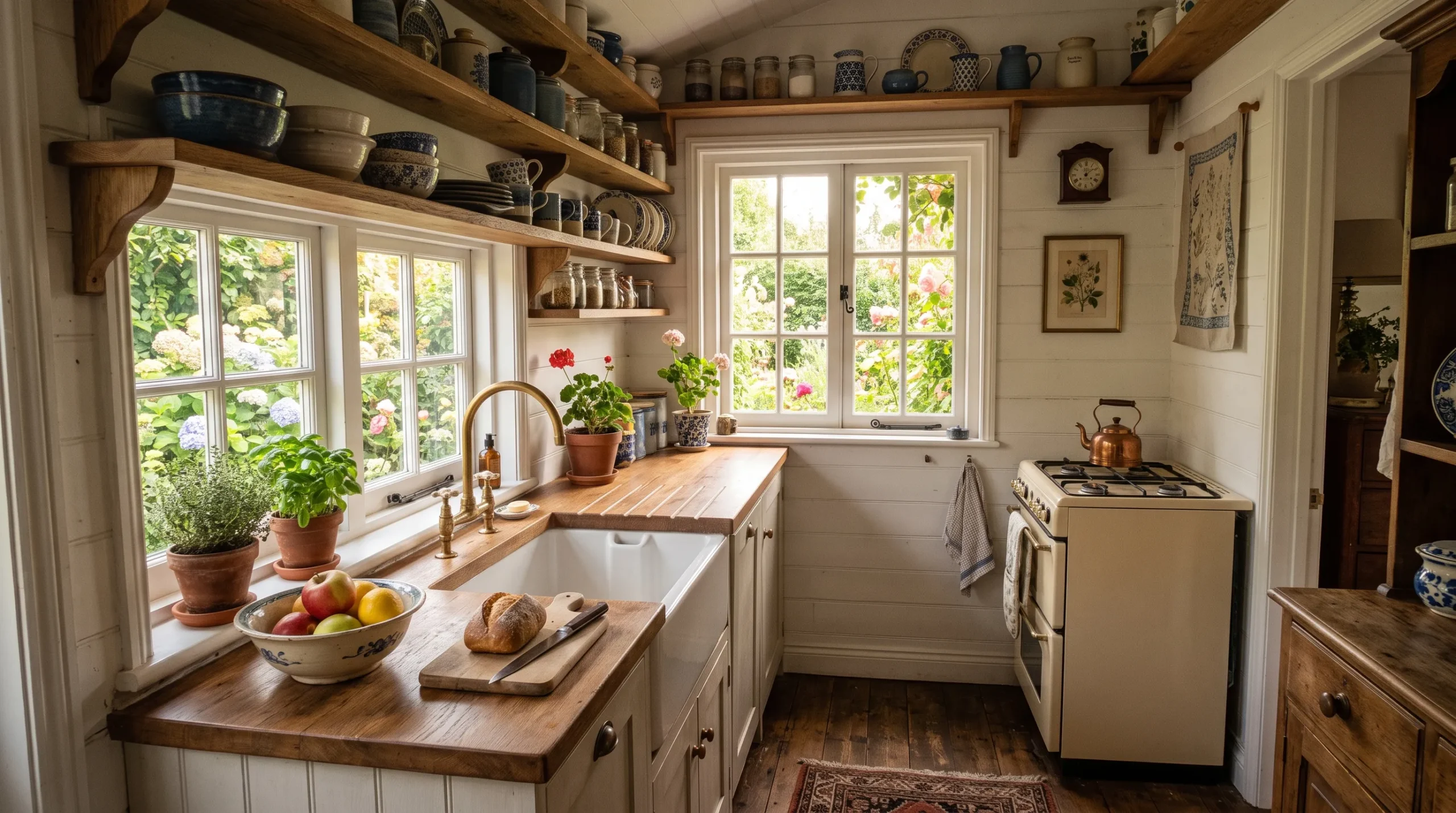
Tiny Cottage Kitchens That Prove Small Spaces Have the Most Soul
Some visuals may be AI-generated when helpful. All opinions are my own.
I have a theory about tiny cottage kitchens and the theory is that constraint is what makes them beautiful. When a kitchen is small enough that every decision about what goes in it is a real decision — not a convenience, not a default, not a leftover — the result is a room where everything belongs. I’ve spent more time than I should looking at tiny cottage kitchens and what keeps drawing me back is that quality of complete necessity. Nothing is there because there was room for it. Everything is there because it was worth the space.

A two-burner range in a tiny cottage kitchen is the appliance that confirms the cook’s priorities — not how much can be made at once but what is worth making carefully. The single window framing the cottage garden does more visual work than an entire wall of windows in a larger kitchen because it’s the only frame the room has for the outside world and that singleness gives it a quality of intention. Everything the tiny cottage kitchen offers, it offers specifically.

A small round table with two mismatched chairs tucked into the corner of a tiny kitchen is the furniture decision that makes the kitchen a complete room rather than just a cooking space. The table belongs to the kitchen — it’s not in a dining room beyond, not a breakfast bar extension — it’s right there within the room and its presence makes the kitchen the place where meals are both made and eaten. Wildflowers in a jam jar on that table confirm that whoever lives here does not distinguish between cooking and living.

The beam of light from the single window at the end of a tiny galley kitchen is the lighting condition that makes the room feel more like a painting than a functional space — the directional light traveling the length of the galley, illuminating the copper pots and the Victorian tiles in sequence, is one of those domestic visual experiences that happens regardless of the designer’s intentions. The tiny galley kitchen with its window at the end has more drama than most large kitchens with their carefully planned lighting.

A Dutch door in a tiny cottage kitchen with the top half open to the garden is the architectural feature that solves the tiny kitchen’s most fundamental challenge — the feeling of enclosure — without adding any space. The garden enters the kitchen through the open top half, the light enters, the air enters, and the kitchen expands psychologically without a single wall moving. The small shelf with its jar of wooden spoons and vintage tins is precisely the right amount of decoration for a kitchen whose door is open to the world.

Floor-to-ceiling open shelving on one wall of a tiny cottage kitchen is the storage solution that puts the kitchen’s entire inventory on display and requires that the inventory be both complete and beautiful enough to display. The glass jars of dry goods, the stacked pottery, the cookbooks, the plants on the top shelf — this is a wall that functions as storage and decoration simultaneously and in a tiny kitchen where there is no room for a wall that does only one thing, that dual function is exactly right.

A single chair beside a small wood-burning cooking stove in a stone-walled cottage kitchen is the tiny kitchen image that goes furthest back in domestic history — this is the kitchen before kitchens were rooms designed as kitchens, when the fire was the kitchen and the chair beside it was the kitchen’s social accommodation. The rough irregular stone walls and the small arched window frame the simplicity rather than apologizing for it and the handmade pottery on the two painted shelves is the beauty that someone added because even the most basic kitchen deserves something beautiful in it.

A window seat just wide enough for one person in a tiny cottage kitchen is the specific spatial gift that makes the room more than the sum of its cooking functions. It is somewhere to sit and look at the garden while the kettle boils, somewhere to read while something simmers, somewhere to be in the kitchen without doing anything in the kitchen. Every tiny kitchen that has room for this accommodation should make room for it because it changes the room’s character from purely functional to genuinely lived in.

A low ceiling in a tiny cottage kitchen is usually described as a limitation and is more accurately understood as a cocooning quality — the room wraps around you rather than simply containing you and the heat from a small Aga in a low-ceilinged room reaches every surface quickly and stays. Herbs drying from the ceiling beam are the detail that turns the low ceiling from a constraint into a feature, using the proximity of the ceiling to the counter as the functional space it actually is.

Painting walls, ceiling, and cabinets all in the same deep sage green in a tiny kitchen is the design decision that uses color to dissolve the room’s boundaries — when there are no visual breaks between wall and ceiling and cabinet, the eye doesn’t measure the distances between them and the room stops feeling small. The cream pottery and copper fixtures are the color departures that make the sage green legible rather than uniform, and the single white linen curtain at the window is the light source that prevents the dark palette from closing in.

A curved counter following the corner angle of a tiny kitchen is the spatial solution that uses the architectural constraint as a design feature — instead of fighting the corner with right angles that create dead zones, the curve embraces it and the working surface becomes continuous and ergonomically useful. The small round mirror on the wall making the space feel larger is the oldest small room trick and it works in a tiny cottage kitchen because the reflection doubles whichever element it faces, adding apparent depth without adding any actual space.

A pegboard above the counter in a tiny cottage kitchen is the wall storage solution that makes cooking in a small space genuinely viable rather than frustrating — the pots are hanging rather than stacked in a cabinet, the utensils are visible rather than buried in a drawer, everything needed while cooking is within arm’s reach without anything being on the counter. The soft blue paint on the pegboard makes it a feature rather than infrastructure and the organized arrangement of hooks and baskets gives it the quality of a thought-out display.

A tiny kitchen organized by how it is actually used — the spoon beside the range, the salt within reach, the knife block on the counter, the herbs in sunlight — is the tiny cottage kitchen whose organization is not a design decision but a cooking decision. The placement of each object reflects the sequence of cooking rather than an aesthetic arrangement, and when function and beauty align in this way, the kitchen looks right in a way that deliberately styled arrangements cannot replicate because the rightness comes from use rather than from intention.

Vintage kitchen tools hung as both decoration and working tools are the tiny kitchen wall solution that refuses the distinction between display and function. The rolling pin is not decorating the wall — it’s hanging on the wall so it’s there when needed, and it looks beautiful in the position it occupies because well-made tools always do. This is the tiny cottage kitchen philosophy applied to the wall: nothing is there because it looks good, everything looks good because it is genuinely there.

The person’s shadow at the edge of the frame in a tiny kitchen at golden hour is the detail that confirms the room is lived in rather than photographed. The shadow is the cook, just out of frame, doing whatever needs to be done at that specific moment in this specific kitchen. The shaft of afternoon sun across the wooden counter and the pot on the range are the elements that make the moment beautiful but the shadow is what makes it real. Tiny cottage kitchens are beautiful because someone is always in them.

Tiny cottage kitchens teach the same lesson that good poetry teaches: when the form is constrained, every choice matters more. The pot that hangs on the wall is there because it’s worth hanging. The shelf holds exactly what should be on it. The window frames exactly the view that needs to be framed. Constraint makes every decision visible and every decision counts, which is why tiny cottage kitchens often have more character than kitchens ten times their size. The size is not the limitation. The size is the discipline.


