
Warm English Cottage Kitchens That Feel Like Coming Home
Some visuals may be AI-generated when helpful. All opinions are my own.
There is a specific quality to English cottage kitchens that I find impossible to fully explain and impossible to stop thinking about. It’s not just the Aga or the flagstone floor or the dresser with the china on it — it’s something about the relationship between all of those things and the sense that the kitchen has been exactly this way for a very long time and will continue to be this way after you leave. American farmhouse kitchens are beautiful. French country kitchens are beautiful. English cottage kitchens are something else. They feel like somewhere you already know even when you’ve never been there before.
The Belfast sink under a sash window looking out to a walled garden is the English cottage kitchen view that has been painted and photographed and dreamed about for centuries because it combines the domestic interior with the enclosed natural world outside in the most specific and English way. The flagstone floor, the cream Aga, the brass hardware — each element is doing its historical and aesthetic work and together they add up to a room that feels like it has a story that started before you arrived.

Spode Blue Italian on a kitchen dresser is the English cottage kitchen china that communicates a specific and unbroken relationship with the tradition of blue and white transferware that has been in English kitchens since the eighteenth century. The geraniums in terracotta pots on the deep windowsill are the English cottage detail that appears so consistently in kitchen photographs that it has become nearly definitional and yet every time the combination of red geranium against white window frame in a cottage kitchen is genuinely beautiful.

An inglenook fireplace in a cottage kitchen is the architectural feature that places the room in a specific lineage of English domestic life going back to when the kitchen hearth was the heat source, the cooking surface, and the social center of the house simultaneously. A wooden settle beside an inglenook is the specific furniture piece that exists only in relation to that fireplace and its presence confirms that the room was built around the fire rather than the fire added to the room.

A pale blue Aga is the English cottage kitchen color choice that makes the room feel seaside and inland simultaneously — the specific blue that reads as both sky and sea and neither — and beside white painted cabinets and pale grey paneling it creates the color palette that English interiors magazines have been returning to for decades because it works differently in English light than it would anywhere else. The silver cake stands are the Sunday afternoon detail that makes the kitchen feel like it has a life beyond the weekday.

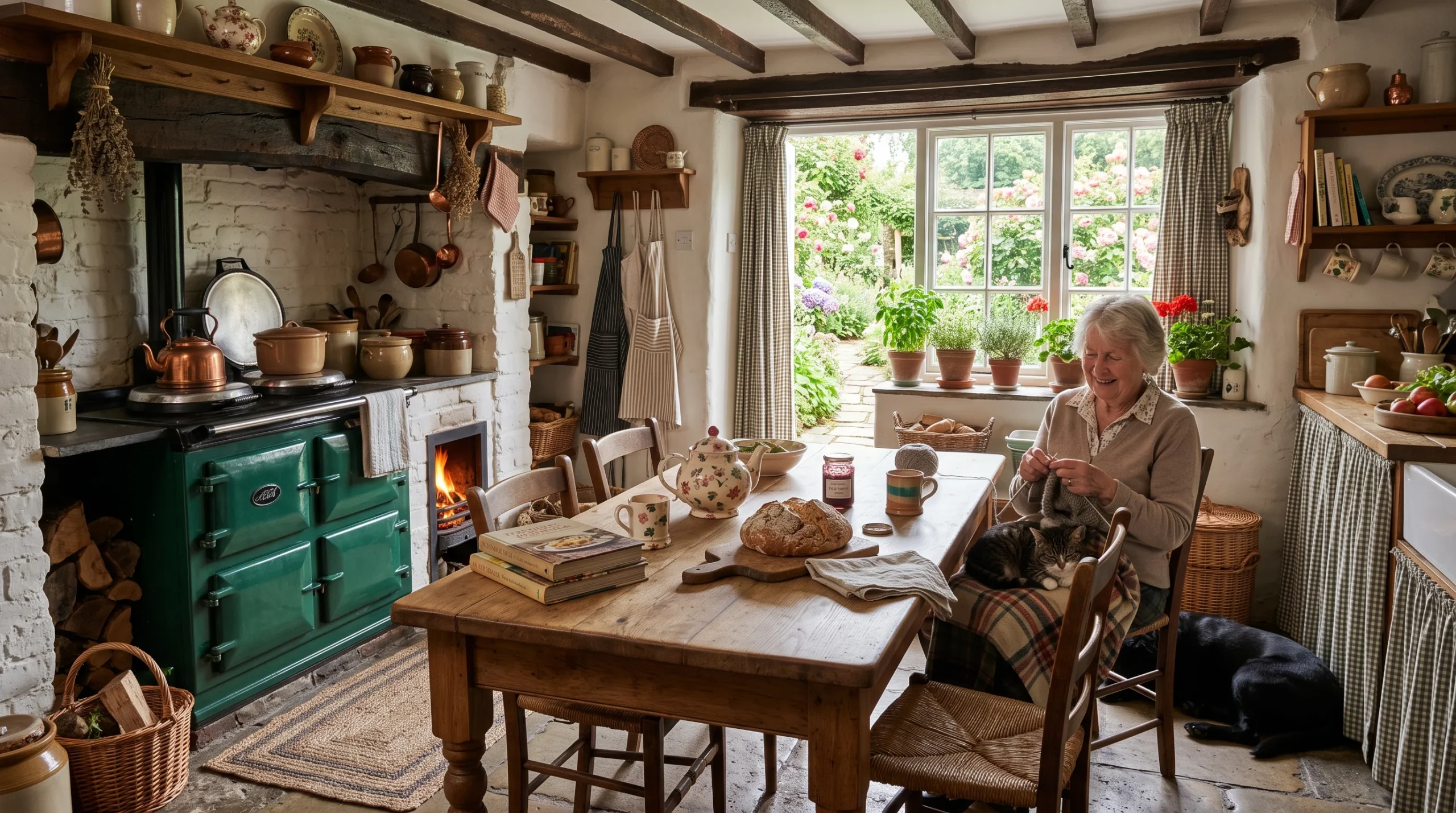
A British racing green range cooker is the English cottage kitchen color statement that announces the room’s personality clearly and confidently. Deep greens in English kitchens have a specific relationship with the landscape outside — the hedgerows, the fields, the garden — and a green range in a beamed kitchen with flagstone and kilim rug is an interior that knows exactly what it is and has known for a long time. The leaded windows are the architectural detail that confirms this kitchen’s age and places it in the English countryside specifically.

The Radio Times on the kitchen table beside the butter and marmalade is the specifically English detail that places this scene in a cultural context that transcends decoration. An English cottage kitchen morning with toast on the rack and rain on the window and the Radio Times on the table is a complete world in a single image and the completeness of it — the specificity of every element being recognizably English and recognizably morning — is what gives it the quality of somewhere you feel you’ve been before even if you haven’t.

Windsor chairs around a round table in an English cottage bay window with roses growing up the garden wall outside is the English domestic image that has accumulated so much visual and emotional weight through repetition in English culture — in novels, in films, in painting, in the actual lived experience of generations of English people — that it carries meaning beyond its visual elements. The jug of sweet peas is the detail that places the scene in summer specifically and the specific sweetness of sweet peas in summer is something that English cottage kitchen photographs communicate with a precision that’s almost unfair.

The glimpse of a scullery through an open door with preserves in rows on stone shelves is the English cottage kitchen depth element that places the room within a larger system of domestic food production that has almost entirely disappeared from contemporary life. Stone shelves for cool food storage, a scullery separate from the main kitchen for heavy work — these architectural spaces were practical solutions that became beautiful through use and age.

Homemade jam labels in careful handwriting are the English cottage kitchen detail that combines the domestic and the botanical and the temporal in a single small object — someone made this, from fruit that was growing recently, in this kitchen, in this season. The preserving pan still on the Aga means the process is ongoing and that ongoing quality makes the kitchen feel like it’s participating in an annual rhythm that will repeat next September and the September after that.

A collection of English studio pottery in warm browns and salt-glazed stoneware is the cottage kitchen dresser display that communicates a specific and deep relationship with the English craft tradition. Denby, Susie Cooper, early studio pottery — these pieces have weight and history and the specific beauty of things made by hand in England that knew exactly where they were going when they were made. Old wooden spoons in a crock by the range are the working tools that belong beside them.

An herb window garden at kitchen level is the English cottage feature that puts the garden at arm’s reach while cooking — the thyme is there, the chives are within reach, the parsley needs no journeying to the garden in the rain. The small watering can beside the pots is the daily maintenance object that makes the window garden feel tended rather than placed, and that tended quality is what cottage kitchen plants require.

Vintage English advertising enamel signs are the cottage kitchen wall decoration that connects the room to a specific moment in English commercial and domestic history — the specific graphic design of midcentury British food advertising, the brand names that every English person of a certain age learned in childhood from their grandmother’s kitchen. PG Tips beside Typhoo Tea beside Bisto beside a meat safe is a wall that tells a story of English domestic life with a specificity that would be impossible to deliberately construct.

An English cottage kitchen at Christmas with a Christmas cake on the table and mince pies cooling on the rack is the seasonal kitchen image that carries the most cultural and emotional weight of any domestic scene in English culture. Holly tucked behind the dresser plates and a simple wreath on the kitchen door are the understated decorating approach that suits the English cottage kitchen because the kitchen itself is already so rich with character that it needs almost nothing to become Christmas.

A sleeping spaniel in the corner of a chintz window seat beside a cold cup of tea and a dog-eared paperback with rain on the garden is the English cottage kitchen scene that encapsulates an entire way of spending an afternoon that has become specifically English through repetition in English literature, English film, and English domestic life. The cold cup of tea means the book was too good to put down. The sleeping spaniel means the afternoon required no explanation. The rain means this was always going to happen exactly this way.

English cottage kitchens have lasted as a design ideal not because they’re aspirational in the conventional sense — not sleek, not minimal, not expensive-looking — but because they represent something that genuinely exists and genuinely works. The warmth is real warmth from a real fire. The character is real character from real use. The beauty is the beauty of things made honestly and kept carefully and lived with for long enough that they’ve become part of the house. That’s not a design trend. That’s just what a kitchen can be if you give it enough time.


