
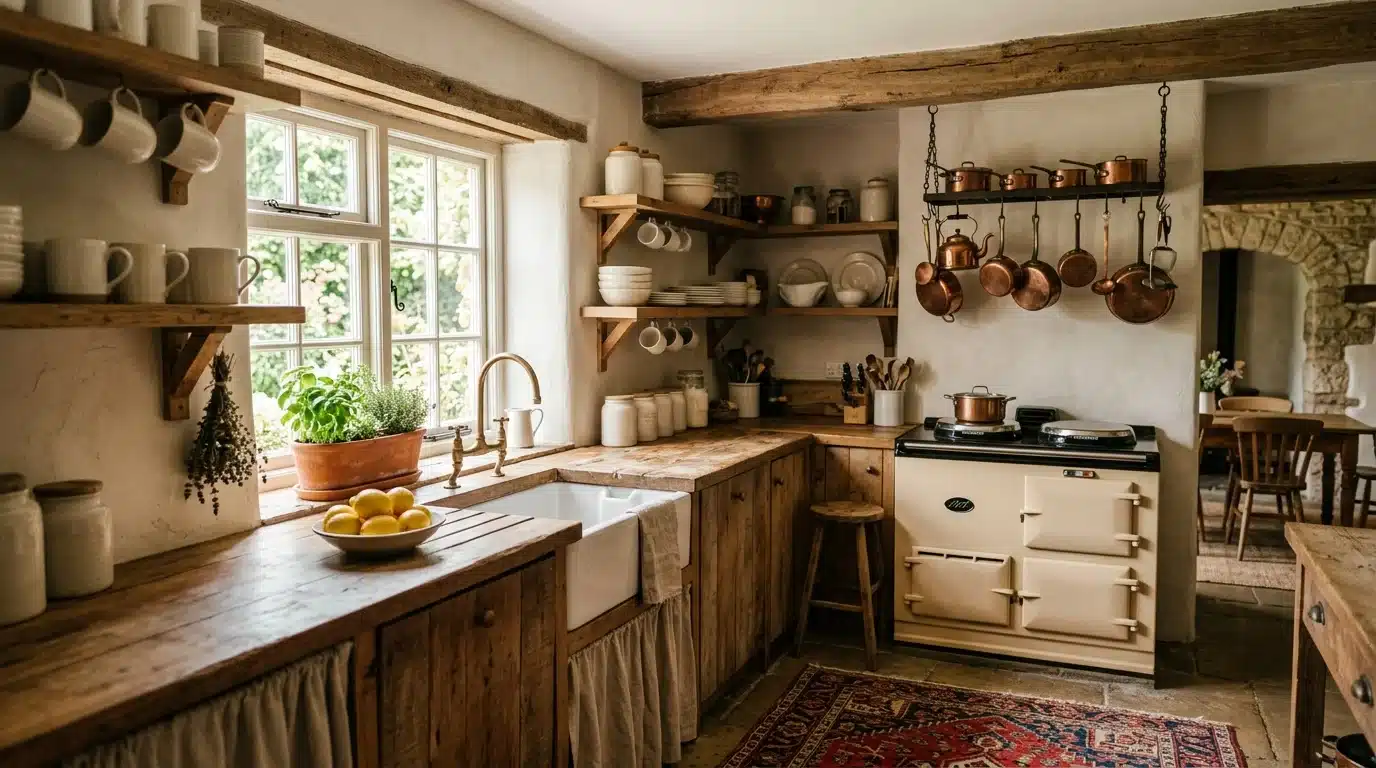
White Cottage Kitchen Ideas That Feel Warm Not Cold
Some visuals may be AI-generated when helpful. All opinions are my own.
The failure mode of white kitchens is coldness — the specific institutional blankness of a white room that hasn’t been thought about carefully enough. Every white cottage kitchen I found that actually works had solved this problem in a different way and what they all had in common was that white was the backdrop, not the design. The warmth came from wood, from aged metals, from plants, from collected objects, from the specific quality of light that white surfaces reflect back into a room when the other elements are right. Here’s everything that makes white cottage kitchens warm.
Warm honey wood countertops in a white cottage kitchen are the material decision that prevents the white room from going cold. The wood brings the natural world indoors in the most literal way — it was a tree, it retains the warmth and color of that origin — and against white painted cabinets the honey tone does everything that marble or quartz cannot: it gets warmer rather than cooler in afternoon light.

White ceramics on white shelving against white beadboard walls sound like they should disappear into each other and instead create the kind of tonal depth that’s only visible when you’re actually in the room — the slight variations between the creamy white of the old dresser, the bright white of the beadboard, the chalky white of the ceramics. The braided rag rug on the stone floor is the color and texture introduction that ties the room to the floor without disrupting the white palette above.

Abundant natural light in a white kitchen is the condition that makes everything else possible — white surfaces in good natural light are warm and living, white surfaces in poor natural light are institutional and cold. The plants on the counter and windowsill are the living elements that bring organic movement and color into a room that would otherwise risk stasis, and the butcher block island top is the wood warmth that grounds the marble and white cabinets.

Handmade subway tile with slightly uneven glazing is the white kitchen backsplash that solves the flatness problem because the inconsistency in the glaze means light hits each tile differently and the surface has movement rather than reflective uniformity. The black iron hardware against the cream-white cabinets is the contrast that gives the kitchen definition — without it everything dissolves into soft white and the room loses the edge that makes it feel resolved.

White ironstone china on a white dresser in a white kitchen is the tonal arrangement that rewards close looking because the slight differences between the ironstone’s heavy cream white and the dresser’s painted white and the muslin curtains’ translucent white are all present but require attention to see. The vintage blue glass and copper cookware are the precise color and material introductions that make the white read as a deliberate choice rather than a default.

All the windows open in a white cottage kitchen in summer with curtains moving in the breeze is the seasonal transformation that makes the room most completely itself. The white surfaces reflect the moving light from the garden outside, the flowers in the white pitcher bring the color of the summer garden in, and the cat sleeping in the sunlight patch on the white floor is the domestic animal doing exactly what it should be doing in exactly the right room. This kitchen needs nothing more.

A kitchen garden window full of white-potted herbs above a white subway tile backsplash with a brass faucet is the white cottage kitchen combination that achieves warmth through contrast — the living green of the herbs, the warm metal of the brass, the natural light from the garden — without adding any element that disrupts the white palette. The garden window is the frame through which the green world enters the white kitchen and that entry is the warmth the room needs.

A pale blue kitchen island in a white cottage kitchen is the color decision that gives the room a focal point and a personality while maintaining the white palette on all surrounding surfaces. The contrast between the island’s blue and the white cabinets and marble is enough to make the kitchen feel specifically designed rather than simply white, and the white peonies on the blue island are the seasonal flowers that bring the garden vocabulary into the kitchen’s color story.

Open lower shelving with natural texture baskets and bowls in a white cottage kitchen is the solution that introduces organic material and warm tone at the level where the kitchen is most used. The natural baskets against the white countertop and white wall above are doing the same work that wooden floors do in a white room — providing the earth tone that grounds everything above it and prevents the white from floating away from the space.

Delft tiles in a white cottage kitchen cooking alcove are the blue and white pattern that has been in English and Dutch kitchens for four centuries and continues to work because the specific blue of Delft against white is one of the most reliably beautiful color combinations in domestic design. The alcove concentrates the pattern in the cooking zone rather than distributing it across the whole kitchen and that concentration makes the tiles a destination within the room.

Vintage white enamelware collected in graduated sizes on open shelving is the white cottage kitchen display that works as art rather than decoration because the forms — the curves of the bowls, the handles of the pitchers — have the specific quality of objects designed to be beautiful and functional simultaneously. The blue or black rim detail on each piece is the line that defines the form and the collection of them together creates a white-on-white composition that has genuine visual interest.

Faded soft teal chairs at a white round table in a white cottage kitchen breakfast nook are the color introduction that makes the nook feel like a discovery within the room — the white kitchen leads to a corner where the color changes subtly and the space becomes specifically for sitting rather than cooking. The faded quality of the teal is the material honesty that makes the chairs feel found rather than chosen, which is the distinction that white cottage kitchens require of their color accents.

A floor-to-ceiling white shelving wall where every object is white or neutral except one or two specific accents is the white cottage kitchen display that requires the most editing and produces the most visually sophisticated result. Each object’s form is visible because color isn’t competing for attention, and the one or two colored pieces have maximum impact because they’re surrounded by white. This is white as an active design decision rather than white as the absence of a decision.

An island with a built-in herb planter is the white cottage kitchen feature that brings the garden inside in the most permanent and functional way — the herbs are growing in the island, at counter height, directly accessible while cooking. The continuous growing trough as the island surface makes the kitchen a working garden as well as a working kitchen and the green of growing herbs against white painted wood is the color contrast that makes the island the room’s undeniable focal point.

Unlacquered brass hardware that has developed a natural patina is the white kitchen detail that changes the room’s perceived age more than any structural decision. Hardware that has been used for years — tarnished in some places, bright in others, developing that specific lived-in quality that coated brass cannot achieve — makes white cabinets that were installed recently read as having been there for a long time. The patina is the evidence of hands reaching for the same handle day after day and that evidence is worth more than any new finish.
White cottage kitchens work when the designer understands that white is a decision about light rather than a decision about color — it’s the choice to let the room be defined by what the light does to it at different times of day and in different seasons. A white kitchen on a gray February morning is a different room from the same kitchen in July afternoon light. The wood, the brass, the plants, the collected objects are not just warming elements — they’re anchors that give the light something to warm. Without them, the white kitchen floats. With them, it settles into itself and becomes a room.


