
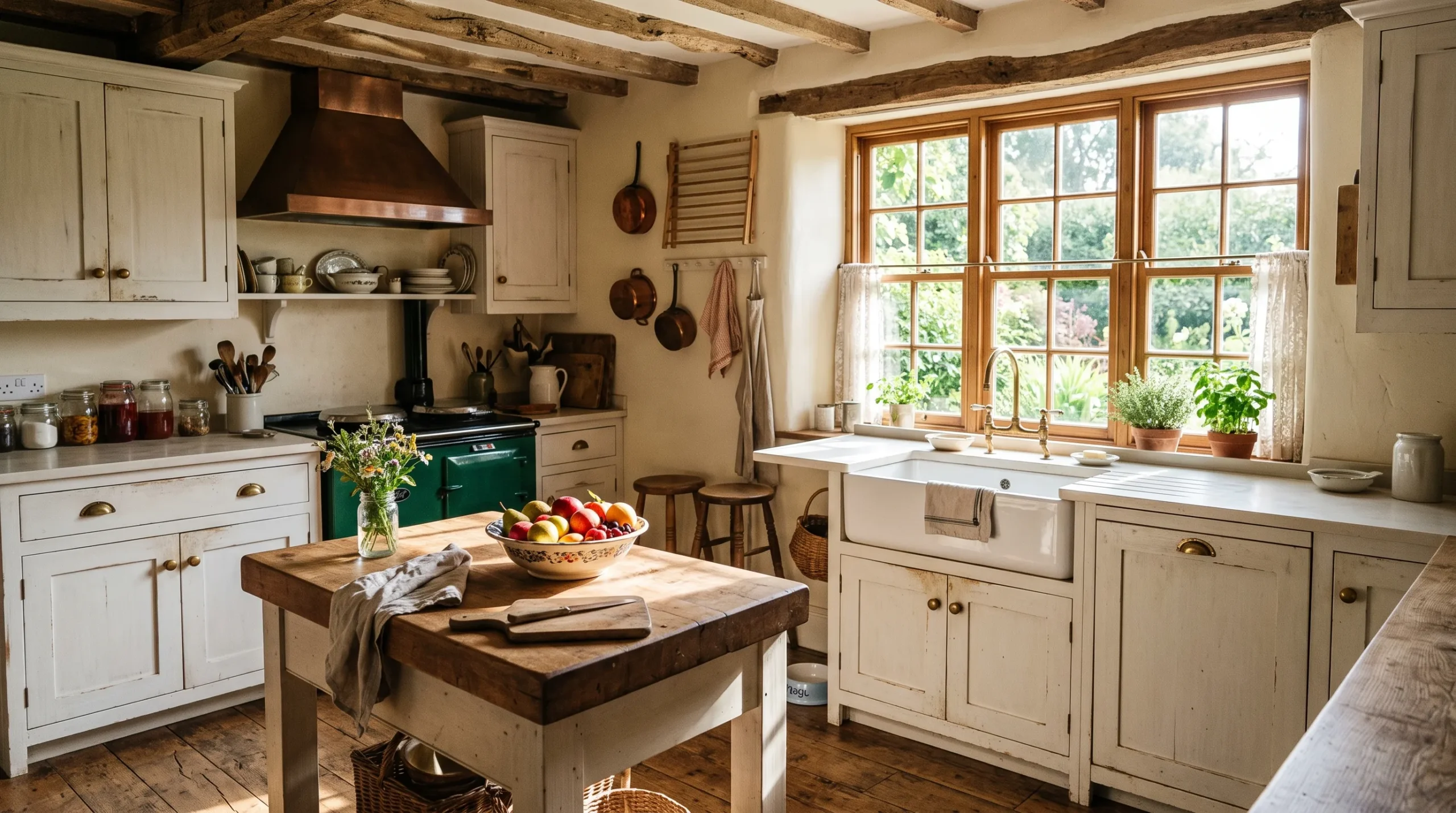
Vintage Farmhouse Kitchens That Feel Like They’ve Always Been There
Some visuals may be AI-generated when helpful. All opinions are my own.
I have a very specific problem with vintage farmhouse kitchens and that problem is that every time I find a photo of a good one I lose approximately forty minutes just looking at it. Not at the whole room — at the details. The specific patina on a copper pot. The way a worn wooden countertop meets a farmhouse sink. The collection of crockery that nobody assembled in an afternoon. The best vintage farmhouse kitchens don’t look decorated. They look like time passed in them and left something behind.
The knife marks in the butcher block island are the detail that separates a vintage farmhouse kitchen that genuinely is from one that’s trying to be. Those marks weren’t made in a day. They were made over years of actual cooking and they carry the biography of every meal that was prepared on that surface. No amount of deliberate distressing produces marks that look like that and anyone who has spent time in real farmhouse kitchens recognizes the difference immediately.

A Hoosier cabinet with its original flour sifter is the vintage farmhouse kitchen piece that belongs in the category of objects that contain their own history. Every Hoosier cabinet came from a specific kitchen, served a specific family, held specific things — and bringing one into a contemporary farmhouse kitchen brings all of that accumulated domestic history with it. The mismatched chairs at the farmhouse table are the furniture version of the same principle: each chair came from somewhere and arrived here.

The pastel green vintage electric range is the farmhouse kitchen appliance that carries an entire mid-century domestic aesthetic in a single object. That specific shade of green — the color that appeared on refrigerators and ranges in the 1950s — communicates a period and a sensibility that no contemporary appliance can replicate regardless of its finish. The black and white linoleum floor is the period-accurate surface that completes the room’s timeline.

A walk-in fireplace with an iron crane in a farmhouse kitchen is the architectural feature that places the room in a specific agricultural history where the kitchen hearth was the heat source, the cooking surface, and the gathering place for the household simultaneously. Using the fireplace space for firewood storage and vintage tool display preserves the visual character of the feature while acknowledging that it no longer performs its original function — that transition between past use and present appreciation is exactly what vintage farmhouse kitchens are about.

Blue and white spongeware on a pine dresser is the vintage farmhouse kitchen china collection that tells a specific story about American rural domestic life in the nineteenth century — the specific pattern created by a sea sponge dipped in cobalt slip was both practical and beautiful in the way that the best farmhouse kitchen objects always are. A complete dresser display of this china communicates decades of deliberate accumulation and that slow accumulation is the quality that makes a vintage farmhouse kitchen feel real.

Canning jars filled with preserved summer produce on open shelves are the vintage farmhouse kitchen display that communicates the seasonal rhythm of farmhouse life more completely than any other single element. The specific colors of the preserved contents — the red of the tomatoes, the gold of the peaches, the green of the beans — make the shelves beautiful in a way that’s also functional, and the vintage calendar still showing August is the detail that places the kitchen in a specific moment of the agricultural year.

A zinc countertop on a turned-leg kitchen island is the material combination that reads as specifically farmhouse because zinc was the practical kitchen surface of the late nineteenth and early twentieth century — it was hygienic, durable, and aged beautifully into the matte silver patina that contemporary design has been trying to replicate ever since. Original wavy glass in the upper cabinets is the glazing that could only have come from the period the kitchen claims, and that authenticity is what makes the whole room feel genuinely vintage rather than vintage-inspired.

A root cellar door in the kitchen floor is the farmhouse architectural feature that most powerfully communicates the relationship between the kitchen and the land beneath it — the cellar holds what the farm produced, accessible from the kitchen where it will be used, the two spaces connected through a door in the floor. A kitchen with a root cellar door is a kitchen that understood its relationship to the land before anyone had to explain it.

A glass-front pie safe with original punched tin panels repurposed as a pantry cabinet is the vintage farmhouse kitchen piece that connects contemporary use to historical function — the pie safe was designed to cool and protect baked goods while allowing airflow through the punched tin, and its current use as a pantry cabinet is continuous with that original storage purpose. The vintage aprons hanging beside it and the original labeled spice tins make the kitchen feel occupied by someone who values and uses these objects rather than someone who simply displays them.

Vintage tin molds hanging from a pot rack alongside cast iron and copper are the baking objects that carry the most specific domestic history of anything in the vintage farmhouse kitchen. Every mold made something specific — a particular cake, a particular pudding, a particular form that the baker returned to season after season — and the collection of them together tells the story of a kitchen that baked with intention over a long time.

Hand-painted tiles original to a 1920s kitchen renovation are the backsplash that has the most legitimate claim to being vintage because they actually are. The specific tulip pattern in blue and yellow, the slight variation between individual tiles, the age visible in the glaze — these tiles were present before any contemporary decisions were made about the kitchen and they carry that continuity. Old recipe cards on a shelf add the paper ephemera that completes the kitchen’s historical dimension.

An enamel-topped table chipped and stained from a century of kitchen work is the vintage farmhouse kitchen piece where the damage is the value. Each chip and stain is evidence of the table having been the center of kitchen life for longer than most people have been alive and that evidence is what makes it genuinely irreplaceable. No contemporary reproduction of an enamel table carries those chips and stains because it hasn’t been used enough yet.

Vintage seed packets framed on farmhouse kitchen walls are the decoration that connects the interior to the agricultural purpose of the surrounding land — the seeds grew things, the things came into the kitchen, the kitchen made meals from them. The circular logic of farmhouse life is present in those framed seed packets and the hand-crank egg beater and root vegetable bin are the functional objects that complete the same circle from a different angle.

A kitchen in active use — flour on the counter, pie being crimped, another cooling on the sill — is the vintage farmhouse kitchen image that carries the most warmth because it’s not decorating for observation, it’s cooking for eating. The slightly imperfect crimp, the flour that went further than intended, the apron doing its job — these are the details of actual cooking and they make the kitchen feel more alive than any amount of careful staging could produce.

Vintage salt-glazed crocks holding utensils and garden scissors along the countertop back are the practical objects that are simultaneously beautiful because they were always designed to be both. Salt-glazed stoneware is the material that comes from American and European folk pottery traditions where the pot’s beauty was an extension of its function rather than an addition to it, and that integration of beauty and use is the principle that makes vintage farmhouse kitchens work as a whole.

The back door open to the farmyard with a cat coming in from outside and a basket of just-gathered eggs on the counter is the vintage farmhouse kitchen summer morning that contains an entire way of life in a single image. The bread rising under its linen cloth and the coffee on the range are the ongoing activities that make the morning specific rather than general. This kitchen is not a set. Someone lives here and is in the middle of a morning that has been happening this way for a very long time.

Vintage farmhouse kitchens work because they’re the physical evidence of a relationship between people and food and land that existed before anyone had to make a design choice about it. The objects that accumulated in those kitchens — the cast iron, the crockery, the crocks, the tools — accumulated because they worked, because they lasted, because they were worth keeping. The best contemporary vintage farmhouse kitchens understand this and make their decisions accordingly. Not what looks vintage but what is worth keeping. The difference shows.


