
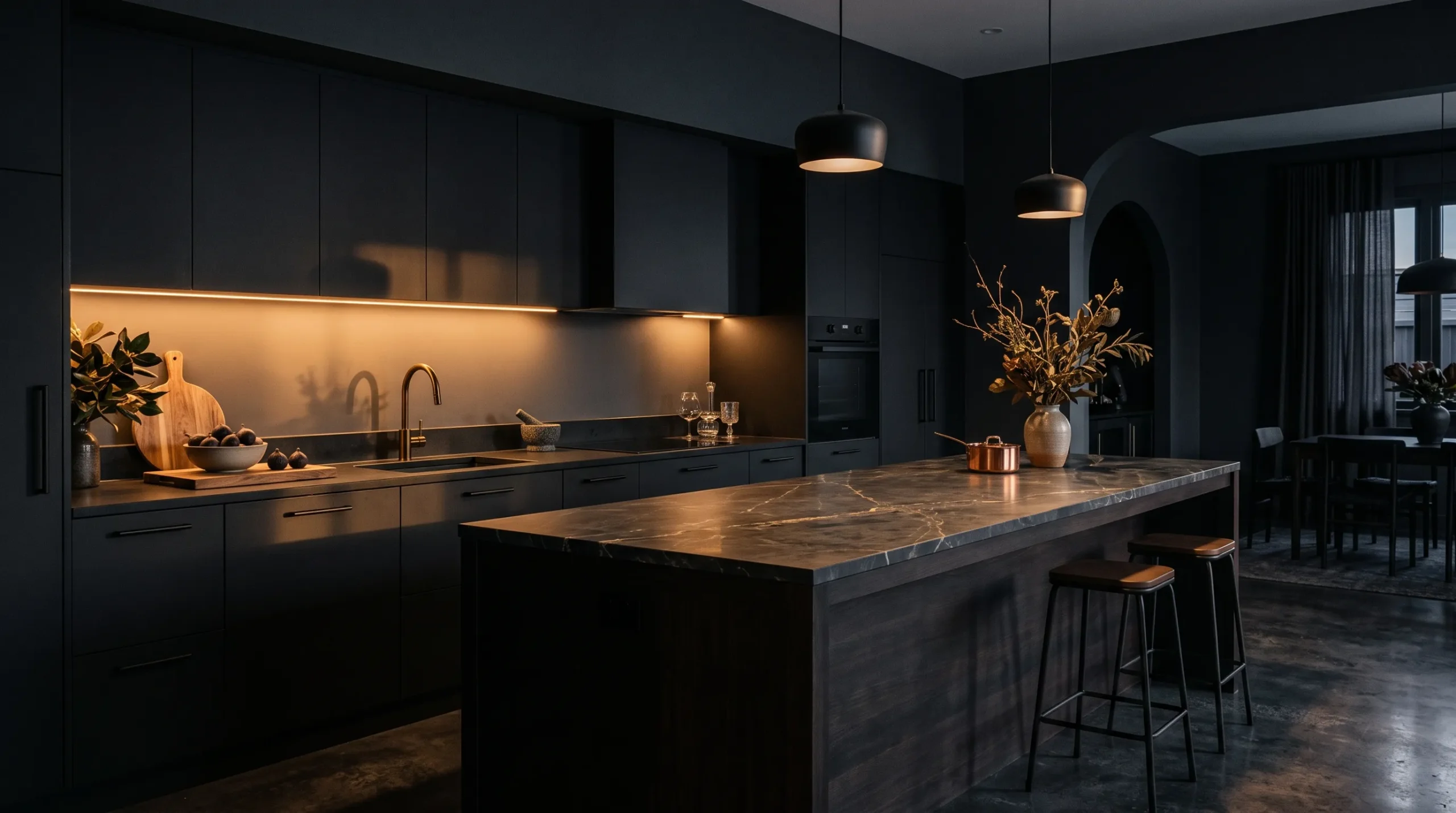
Dark Moody Kitchen Ideas That Make You Feel Something
Some visuals may be AI-generated when helpful. All opinions are my own.
I used to think dark kitchens were a mistake. A kitchen should be bright, I thought, practical, well-lit, optimized for the visual demands of cooking. Then I found a photo of a kitchen with deep forest green cabinets and brass fixtures and a pendant casting a warm pool of light over a dark marble island and something shifted because that kitchen felt like somewhere I wanted to be rather than somewhere I wanted to cook efficiently in, and I realized those are different things. Dark moody kitchens are not practical kitchens made dark. They’re kitchens that decided atmosphere was worth having.
Navy blue cabinets floor to ceiling with brass hardware and black marble countertops is the dark moody kitchen color scheme that works because every element is in conversation with the others — the navy deepens against the black marble, the brass lifts both, and the white veining in the marble is the light element that prevents the room from collapsing into pure darkness. The gray natural light from the uncovered window is the contrast that makes the warm brass pendant light meaningful.

Warm walnut as the single warm material in a charcoal and matte black kitchen is the design decision that makes the dark palette livable. Without it, the charcoal and black read as cold regardless of the pendant’s warmth. The walnut island surface catches the light from the pendant above and glows in a way that the matte black surfaces around it don’t, and that specific glow is what gives the dark moody kitchen its warmth. One warm material is all it takes but that material must be present.

Painting walls and cabinets in the same deep forest green so that they dissolve into each other is the dark moody kitchen technique that makes the room feel like it has been carved from a single dark material rather than assembled from components. The white countertops are the contrast that defines the work surfaces against the surrounding darkness and the hanging plants from the ceiling are the life element that prevents the dark enveloping green from feeling like a room that has closed in on itself.

Emerald green zellige tile backsplash against black cabinets is the dark moody kitchen combination that uses the handmade imperfection of the zellige tiles as the room’s jewel — each small tile catching light differently, the mosaic surface creating movement within the dark kitchen. The brass fixtures against the black and green palette are the gold notes that make the whole combination feel rich rather than simply dark. This is a kitchen that is dark because it wanted to be this beautiful and being this beautiful required darkness.

Burgundy red cabinets in a dark moody kitchen are the color choice that introduces warmth into the dark palette in the most intense way — the deep red is simultaneously dark enough to maintain the moody quality and warm enough to prevent the coldness that pure charcoal or black can create. The vintage round mirror on the wall is the dark moody kitchen space-expanding device that works because it reflects the warmest parts of the room — the under-cabinet glow, the brass fixtures — rather than the dark surfaces.

Raw concrete walls in a dark moody kitchen are the surface that makes the industrial aesthetic genuinely industrial rather than styled as industrial. The specific gray of unsealed concrete is cool and heavy and the combination of that surface with matte black cabinetry and aged steel pendant is a kitchen that has committed to a material honesty that most dark kitchens only approximate. The natural wood island countertop is the warmth that makes the honesty livable.

Painting Victorian architectural features — picture rail, cornicing, ceiling rose — in the same dark color as the kitchen cabinets and walls is the period kitchen dark treatment that honors the architecture by including it in the design decision rather than working around it. The ceiling rose becomes the specific point from which the pendant descends into the room and that descent from the ornamental center of the ceiling is both architecturally appropriate and atmospherically perfect.

Cabinet interiors in a deep contrasting jewel tone while the exterior fronts are charcoal is the dark moody kitchen detail that rewards the act of opening a cabinet. The teal or cobalt interior glowing behind the charcoal exterior is a surprise that makes the dark kitchen have a secret — a warmth and color that is present but not immediately visible, revealed only when the kitchen is in active use. This is dark moody kitchen design that understands the value of hidden beauty.

A hammered copper range hood aged to a dark brown-gold in a charcoal kitchen is the object that the kitchen was designed to frame. Everything else in the kitchen is dark and flat so that the copper hood — with its texture, its patina, its handmade quality — stands as the room’s single expressive object. Designing a kitchen around one extraordinary piece is the dark moody approach that produces the most memorable result because the kitchen and the hood are in an active compositional relationship.

A dark moody kitchen at night with three light sources — under-cabinet, pendant, and candles — and darkness everywhere between them is the kitchen that demonstrates the core principle of the dark moody aesthetic: darkness is not the absence of light, it’s the context that makes light meaningful. The warm pools of light against the dark surfaces, the candle flames catching the brass fixtures, the shadow in the corner — this is a kitchen that is most beautiful precisely at the time of day when most kitchens are least beautiful.

Black calla lilies and burgundy dahlias in a dark kitchen on a clear island surface is the dark moody kitchen decoration that works by adding a living element to the darkness that has the same color vocabulary as the kitchen itself. The dark flowers in the dark kitchen are not decoration placed in a dark room — they are extensions of the room’s palette into an organic form and the specific beauty of dark flowers against dark surfaces is one of the most sophisticated decorating choices available in any room.

Natural slate as a backsplash in a matte black kitchen introduces texture into a palette that would otherwise be entirely flat — the specific rough surface of stacked slate absorbs and reflects light differently across its varied planes and the kitchen gains a surface with genuine character rather than a surface with a specific color. The single walnut shelf above the slate is the precision warmth introduction that gives the textural dark wall its compositional anchor.

Steel-framed grid windows in a dark moody kitchen are the architectural feature that makes natural light specific rather than abundant — the grid divides the light into sections and each section falls on the dark surfaces differently. The industrial steel frame contributes to the kitchen’s material vocabulary and the way the gridded light moves across the charcoal surfaces throughout the day gives the kitchen a daily performance that purely artificial lighting cannot provide.

A collection of vintage brass and copper cookware illuminated by directed light against a deep green wall is the dark moody kitchen still life where the functional objects become the art. The warm aged tones of the copper and brass against the deep green background is a color composition that would work as a painting, and the directed light on the cookware makes the display gallery-quality. This is a kitchen that treats its tools as beautiful objects deserving of presentation.

Removing upper cabinets and replacing them with open shelving in the same dark charcoal as the lower cabinets and the wall behind them is the dark moody kitchen decision that treats storage as a design element rather than a functional requirement. When the shelving and wall are the same color, the objects on the shelves — the carefully edited dark pottery and cookbooks — appear to float in darkness rather than sit on surfaces, which gives the kitchen wall a depth and mystery that glass-fronted or differently colored shelving cannot achieve.

A live edge wood island in a dark moody kitchen is the natural wood element that is most specifically different from the darkness surrounding it — the organic irregular edge, the specific grain of a single tree, the warmth that live edge wood carries from the forest it came from — all of these qualities are most visible against a dark backdrop. The dark kitchen is the ideal setting for live edge wood because the contrast makes both the wood and the darkness more themselves.

Dark moody kitchens work because they made a decision about what kind of room they wanted to be and committed to it completely. The warmth in a dark kitchen is not casual — it’s specific, directed, earned. The brass fixture against the charcoal cabinet. The walnut island in the black kitchen. The copper cookware illuminated on the green wall. These are all moments of warmth that exist in specific relationship to the darkness around them and they are more beautiful for that relationship than they would be in a kitchen where everything is uniformly warm. Dark moody kitchens understand that warmth means more when it has been found in the dark.


