
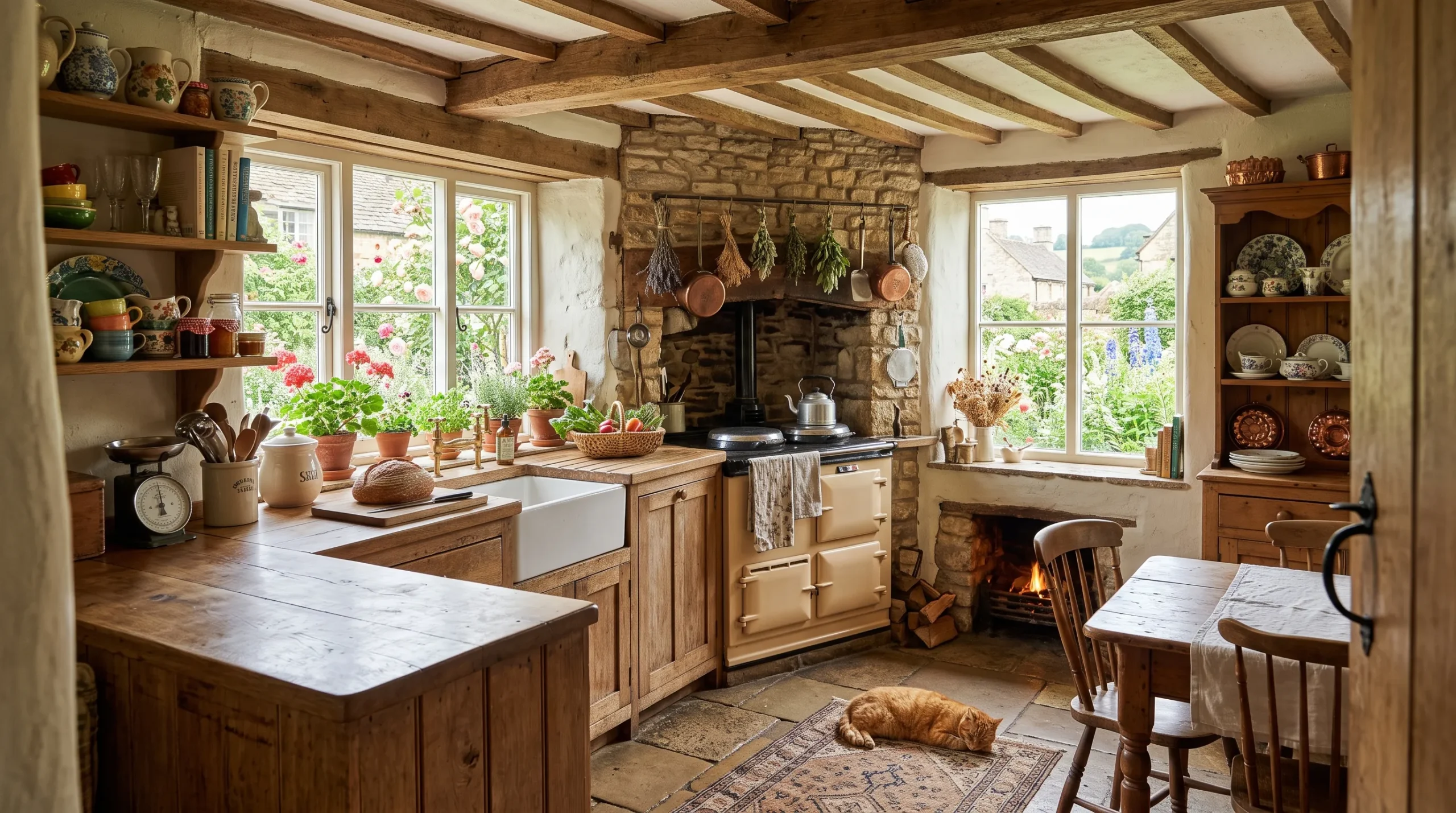
European Cottage Kitchens That Make You Want to Move Abroad
Some visuals may be AI-generated when helpful. All opinions are my own.
I have a very specific problem and the problem is that European cottage kitchens make me want to leave my life and move to a stone farmhouse in Provence or a thatched cottage in the Cotswolds or a hilltop village house in Tuscany. I know this is impractical. I also know that every time I find a photo of a French farmhouse kitchen with its worn terracotta floor and its hanging copper pots and its view of a lavender field I spend a significant amount of time thinking about real estate prices in the Luberon. Here is everything that causes this problem.

French faience pottery in blue and yellow on ochre walls above terracotta floors is the Provençal color story that has been accumulated over centuries of Provençal domestic life and every element earns its place because it came from the same geographic and cultural context. The fig tree visible through the open French doors is the specific Provençal garden plant that places the kitchen in its landscape — you cannot see a fig tree through open kitchen doors in warm afternoon light and not feel that you are somewhere specific and specifically beautiful.

Tomatoes from the garden in a bowl on the Tuscan kitchen table are the kitchen prop that communicates everything about the Italian relationship between kitchen and garden — the garden produced the tomatoes this morning, the kitchen will use them this evening, and the bowl on the table is the transit point between the two. The olive trees on the hillside through the small window are the landscape that the kitchen belongs to and the wine in the rack confirms that the kitchen is part of a culture that takes both cooking and eating seriously.

Blue shutters open to a sea view in a Greek island cottage kitchen are the architectural feature that places the kitchen in its geography more completely than any interior element. The white-washed walls, the blue painted cabinet doors, the handmade blue and white ceramics — these are the specific visual vocabulary of the Greek island domestic interior and they work as a combination because they were developed together in the same climate, with the same materials, over the same centuries of island life.

Hand-painted azulejo tiles on a Portuguese kitchen backsplash are the decorative element that carries the full weight of Portuguese visual culture in a domestic installation — the specific patterns, the specific blue, the specific tradition of tile painting that has been part of Portuguese architecture since the sixteenth century. Alongside clay cooking pots and a string of garlic hanging from a hook, the kitchen announces its nationality and its regional identity without any text or explanation.

Talavera tiles on the range surround of an Andalucian kitchen are the Spanish ceramic tradition in its domestic context — the specific colors, the specific patterns, the specific warmth of Spanish polychrome tilework that has been present in Spanish kitchens since the Moorish influence that shaped Iberian ceramic culture. The cazuelas on the open shelves are the Spanish cooking vessels that belong in this kitchen specifically because they were made for the cooking that happens in it.

Half-timbered walls visible on the interior of a Norman farmhouse kitchen are the structural feature that makes the building’s construction the room’s decoration — the oak beams are the wall, the plaster between them is the wall, and no additional decoration is required because the materials themselves are beautiful and historically specific. The iron pot crane in the stone fireplace is the cooking infrastructure of a kitchen that was built before ranges existed and has accommodated cooking from fire ever since.

The red Falun paint on the exterior visible through the Swedish cottage kitchen window is the detail that places the interior in its specific geographic and cultural context — that particular deep red of traditional Swedish farmhouse exteriors, painted with the specific pigment from the Falun copper mine that gave Swedish rural architecture its characteristic color, is immediately recognizable as Swedish. The interior with its blue cabinet fronts and cotton check curtains is the complement to that exterior in the specific way that Swedish cottage interiors have always complemented their exteriors.

A floor-to-ceiling wall of individually painted Delft tiles in a Dutch farmhouse kitchen is the domestic installation of the Dutch ceramic tradition at its most ambitious and most beautiful. Each tile painted with a different blue and white scene — boats, windmills, children playing, skaters — creates a wall that rewards hours of looking. The kitchen with this tile wall is a kitchen that contains a four-hundred-year visual history within its most functional room.

The flagstone floor, faded blue dresser, and window looking out to Atlantic fields and stone walls in an Irish cottage kitchen are the combination that places the room in the specific landscape and tradition of Irish rural domestic life. The pot of strong tea on the range and the bread cooling on the counter are the ongoing activities that make the kitchen feel inhabited in real time, and the Atlantic light — soft, often gray, occasionally golden — is the specific quality of Irish natural light that makes these kitchens look different from any other European cottage kitchen.

A large worn marble table used as both preparation and dining surface is the Belgian farmhouse kitchen piece that refuses the distinction between work and meal that most kitchen design builds around. The marble table is the kitchen and the dining room simultaneously — you prep on it, you eat on it, you cover it with Belgian linen when the meal is served. The gray Belgian light and the stoneware in creams and grays give the kitchen a northern coolness that is its own specific kind of beauty.

Painted panel cabinet doors with folk art flowers and birds in a Bavarian kitchen are the German regional craft tradition in its domestic application — the specific patterns, the specific colors, the specific style of painted decoration that has been applied to Bavarian furniture since the seventeenth century. The pewter alongside blue and white German pottery on the dresser completes the material inventory of a Bavarian farmhouse kitchen that knows exactly what it is.

Paprika drying in strings from ceiling hooks is the Hungarian kitchen detail that the cuisine and the kitchen share with complete logic — the paprika that defines Hungarian cooking grows in Hungarian gardens and dries in Hungarian kitchens before becoming the specific warm red spice that goes into the goulash. The hand-painted pottery in red and black on the shelves is the Hungarian folk ceramic tradition present in the kitchen and the embroidered textiles are the needle craft tradition present in the same room. Everything in this kitchen comes from Hungary.

Polish Łowicz folk art patterns painted as borders around window and door frames are the specific regional Polish decorative tradition of painting geometric and floral motifs directly onto the architecture of the room. The patterns are specific to the Łowicz region and their presence in a kitchen announces both national and regional identity in the most direct possible way — the walls themselves are decorated with the culture’s visual vocabulary and the pottery and embroidered tablecloth continue that vocabulary into the room’s objects.

Zellige tile walls in turquoise, cobalt, and saffron yellow in a Moroccan riad kitchen are the North African ceramic tradition expressed at its most complete and most beautiful — each small handcut tile fitted into the geometric pattern by a craftsman following a tradition that has not fundamentally changed in seven centuries. The arched niches holding spices and cooking vessels are the Moroccan domestic architecture that organizes the kitchen around the specific ingredients of Moroccan cooking, and the carved plaster screen filtering the courtyard light is the light quality that is specifically Moroccan.

Pine-clad walls and ceiling in a Swiss chalet kitchen with a view of alpine meadow through the window are the materials and geography that together make the room specific beyond any decoration. The tiled range area with hand-painted Swiss mountain scenes and the hand-carved chairs are the regional craft elements that confirm the kitchen’s national identity, but the alpine light through the window and the specific scent of pine-clad walls in a warm enclosed space are the things that no photograph can fully transmit and that anyone who has been in such a kitchen will immediately recognize.

European cottage kitchens work as aspirational objects because they represent something that takes time to make — not money, time. The French faience collection accumulated over generations. The Delft tiles on the wall were put there in the seventeenth century. The Belgian marble table has been used so many times it has worn. The Irish dresser has held plates through multiple inhabitants of the house. What makes these kitchens compelling is not that they look a certain way but that they arrived at looking that way through being genuinely used and genuinely cared for over a long period by people who cooked real food in them. You cannot buy that. You can only begin it.


