
Warm Minimal Kitchen Decor That Proves Less Is More
Some visuals may be AI-generated when helpful. All opinions are my own.
Minimal kitchens have a failure mode that most people have experienced: the cold, empty, clinical space that looks like a showroom rather than a kitchen. Warm minimal is a different thing entirely and it’s harder to get right because it requires genuine restraint alongside genuine warmth — the discipline to remove everything that isn’t necessary combined with the wisdom to keep the things that make a kitchen feel like somewhere a person actually lives. The kitchens that get this balance right are the ones I find myself returning to because they look exactly right and almost nothing is happening in them.
Three objects on a shelf — a ceramic bowl, a small plant, a wooden cutting board — is the warm minimal kitchen display that works because each object was chosen to stay and nothing else made the cut. The ceramic bowl has form, the plant has life, the cutting board has warmth. Between them they cover the three qualities a minimal kitchen shelf needs to provide and nothing else is required. Adding a fourth object would begin the collapse of the arrangement.

A walnut island in a white minimal kitchen is the single warm element that changes the room’s character completely — the white kitchen without it is cold, the white kitchen with it is warm, and the walnut does this through material presence alone without any decoration. The single large brass pendant above it is the second warm element and the bowl of lemons is the third and final one. The kitchen has exactly three departures from white and each one earns its place.

Floor-to-ceiling flat-front oak veneer cabinets with no handles in a minimal kitchen are the storage solution that turns the entire wall of cabinets into a single warm wooden surface — not a cabinet wall with handles but a warm panelled wall that happens to contain everything. The wood grain running floor to ceiling without interruption gives the kitchen a material richness that requires no decoration because the material itself is the decoration.

The tree visible through the window above the sink is the warm minimal kitchen’s most powerful feature because it’s not decoration — it’s the world outside entering the kitchen through the frame of the window. A kitchen whose main visual element is a tree seen through a window is a kitchen that doesn’t need anything else to be interesting and the objects on the counter acknowledge this by reducing to a single cutting board and one small plant. Everything is in service of the window.

Terracotta colored flat-front cabinets in a minimal kitchen are the warm minimal approach that introduces warmth through color rather than material or decoration. The specific terracotta — the color of fired clay, of Italian floors, of old Mexican walls — has a warmth that reads differently from warm gray or warm beige because it’s associated with the earth and the sun in a way that compound neutrals aren’t. Five precisely spaced objects on a shelf is the arrangement that keeps the terracotta kitchen from needing anything else.

A thick marble countertop in a warm minimal kitchen is the single material decision that adds the most luxury with the least decoration. Thick marble with good veining has a presence that requires nothing placed on it to be beautiful — it is the decoration — and three apples in a ceramic bowl on a thick marble counter in afternoon light is the still life that makes a minimal kitchen feel as though it was designed by someone who knew exactly what they were doing.

Visible joinery detail in a minimal kitchen island is the craft element that gives the room something to look at closely — the specific way the drawer is constructed, the care in the fit, the beauty of joinery done well. Most minimal kitchens hide their construction behind flat surfaces and handle-free fronts, and the one island with visible joinery detail that rewards inspection becomes the kitchen’s quiet statement about the difference between minimal and empty.

A warm minimal kitchen fitted within the original architecture of a period room is the design conversation between new and old that requires the most confidence because the minimalism must be resolute without destroying the character of the historic room. The original cornice and ceiling rose above the flat-front minimal cabinets is the combination that puts a contemporary kitchen inside a room that predates it by a century, and the conversation between the two periods is the room’s entire interest.

A moka pot and two small cups on a clean countertop at a window with morning light is the warm minimal kitchen scene that contains everything that needs to be there and nothing that doesn’t. Two people, two cups, one coffee pot, one window. The kitchen around it exists to make this moment possible and has been designed not to compete with it. That subordination of the kitchen to the life happening in it is the warm minimal kitchen’s highest achievement.

A maximally integrated kitchen where the refrigerator, dishwasher, and range are all behind matching panels is the minimal kitchen taken to its logical endpoint — a room that is a series of warm putty surfaces interrupted by nothing, whose function is entirely concealed, and whose beauty is in the unbroken continuity of the surface. A single wooden board on the counter is the one object that reveals that a person uses this kitchen and cooks in it and that single revelation is all the warmth the room needs.

A single open shelf running the full length of the kitchen with objects placed at considered intervals is the warm minimal kitchen feature that requires the most editing because the single shelf must carry all the room’s visual interest without any competing element. A series of ceramic canisters in graduating heights, a wooden mortar and pestle, three cookbooks, one small plant — each object was chosen and placed and the result is a composition rather than a collection.

A kitchen whose warmth comes entirely from the floor and cabinet color — no wood, no plants, no objects — is the warm minimal approach that trusts material completely. The large format warm sand tiles and the cabinets in a slightly deeper sand are the only warmth in the room and they’re enough because the color family they occupy has a specific quality of late afternoon light that northern hemisphere cultures associate with warmth at a level below conscious awareness. The arched window and aged brass pendant are the two details that give the sand palette its Mediterranean reference.

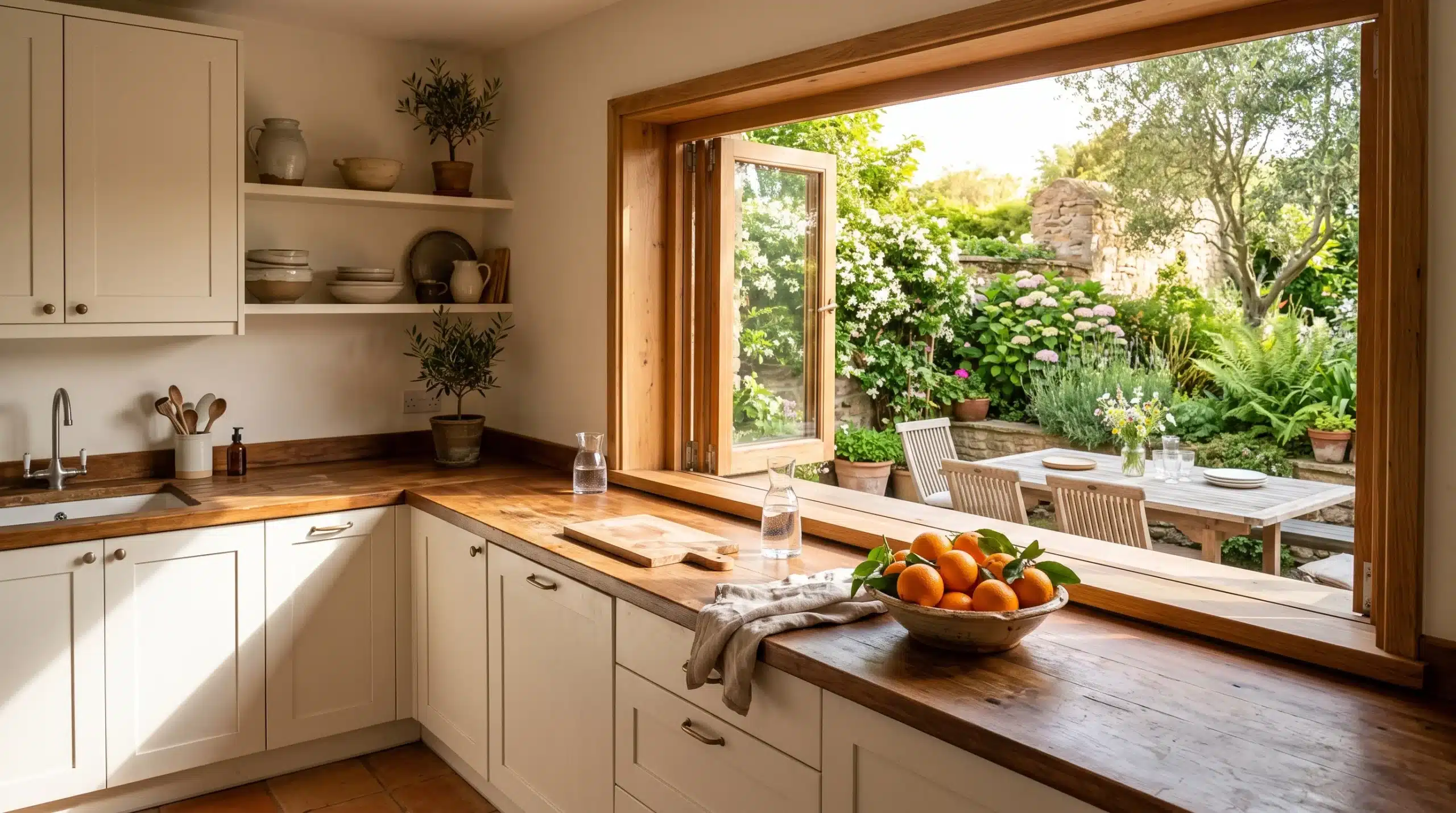
A pass-through window to an outdoor terrace in a minimal kitchen is the architectural feature that resolves the tension between indoor minimal and outdoor abundance by giving the garden a frame through which to enter the kitchen. The morning light through the pass-through illuminating the white interior, the bowl of oranges on the wooden counter, the garden visible beyond — the kitchen is connected to the outside world through an opening and that connection is the warmth that minimal materials alone cannot always provide.

The warm minimal kitchen at dusk — the moment when natural light fades and the under-cabinet lighting becomes the primary source — is the time when minimal design shows its full value because in that transitional light the warm surfaces absorb and reflect the artificial warmth in a way that makes the room feel like it’s generating its own heat. A single candle starting to matter on the counter and a glass of juice beside it complete the transition from day kitchen to evening kitchen and in that transition the warm minimal kitchen becomes the room you want to be in.

The view from the range looking out across a minimal kitchen is the perspective that reveals whether the kitchen works not as a design object but as a kitchen — the clear counters that make prep possible, the bowl of fruit that feeds the cook, the dining table visible beyond that is waiting for the meal. A minimal kitchen viewed from the cook’s position is either a kitchen that works or a kitchen that looks good, and the best warm minimal kitchens are the ones where those two things are the same.

Warm minimal kitchen decor is about knowing what to keep and having the confidence to remove everything else. The wood, the ceramic, the plant, the one bowl of fruit — these are the objects that earn their place because they bring warmth or life or beauty that the materials alone don’t provide. Everything else is the kitchen trying to be something it doesn’t need to be. The discipline of warm minimal is not austerity. It’s the specific satisfaction of a room where nothing is there without a reason and every reason is a good one.


