
Cozy Rustic Kitchens That Make You Want to Cook Everything From Scratch
Some visuals may be AI-generated when helpful. All opinions are my own.
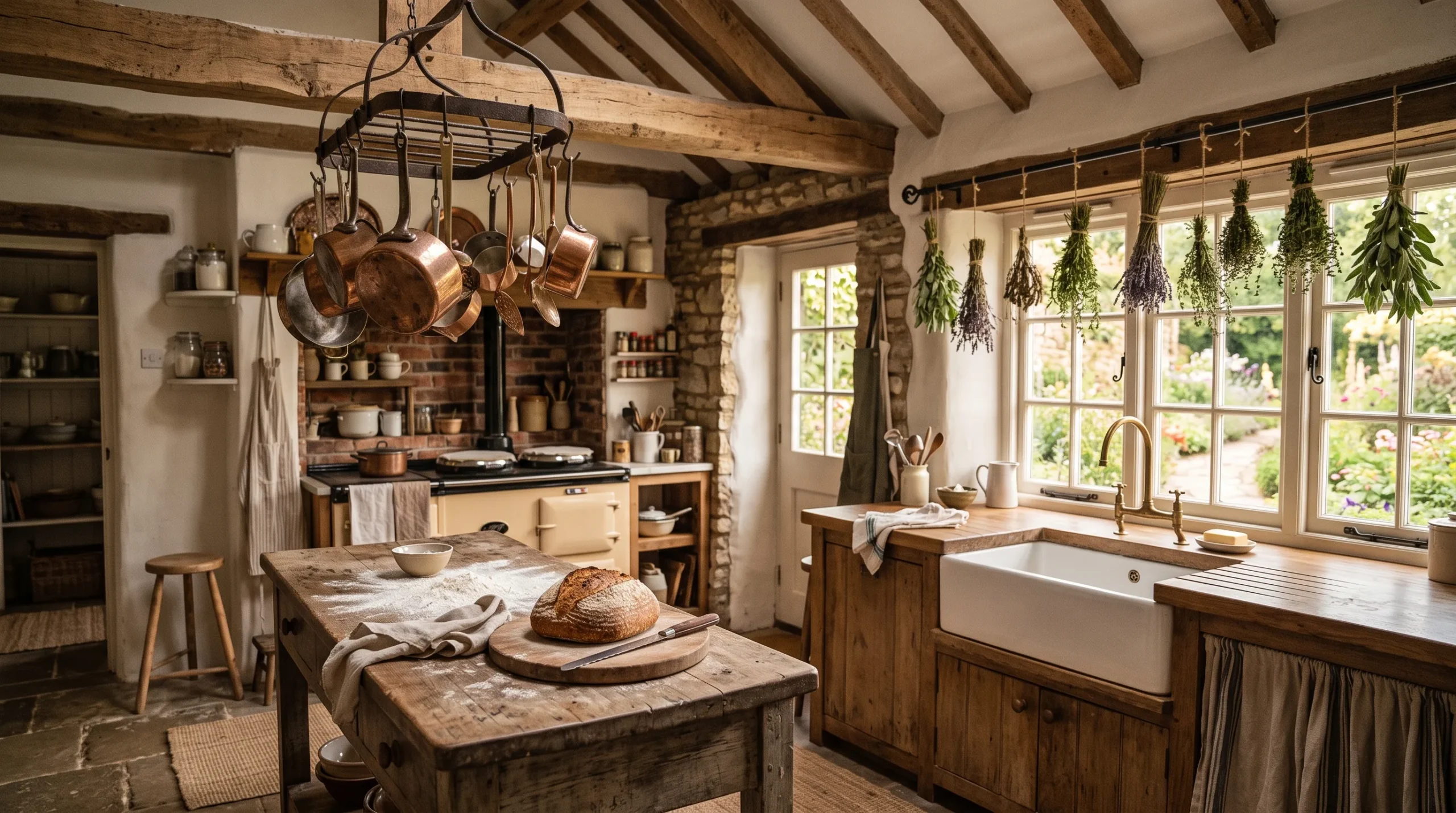
The rustic kitchen is the one that makes me rethink everything about my relationship with cooking. Not because the food coming out of it is necessarily better — though it often is — but because the kitchen itself makes cooking feel like something worth doing slowly. The stone walls, the wooden surfaces, the open fire, the way everything has weight and age — these are not just aesthetic choices. They change what it feels like to be in the kitchen and that change makes you want to stay there longer and cook more deliberately than you would in any other kind of room.
The open hearth with a fire burning in a rustic kitchen is the element that changes the room’s entire thermal and sensory character — the warmth is directional rather than ambient, the light is moving rather than fixed, the smell of wood smoke enters everything in the kitchen in the most pleasant way. Everything else in the room — the stone walls, the beams, the flagstone — makes sense in relation to the fire, which is the original reason all of it was built.

Terracotta tiles and ochre plastered walls in a Mediterranean rustic kitchen are the materials that change the light quality of the room — both surfaces absorb and re-emit warmth in a way that makes the afternoon light in such a kitchen feel specifically golden rather than simply yellow. The dried chili peppers hanging from the beams alongside the herbs connect the kitchen directly to the growing season that recently ended and the cooking season that is ongoing.

Deep forest green rough plaster walls in a rustic kitchen are the color and material combination that makes the room feel like it’s been exactly this way for a century regardless of when it was actually finished. The rough plaster catches light differently at different times of day and the green darkens in the corners and lightens near the windows in a way that gives the room natural depth. Heavy pottery in earthy browns and greens on the plate racks extends the color palette from wall to shelf without any decision feeling deliberate.

Narrow beams of sunlight through small barred windows in a stone-vaulted rustic kitchen are the lighting condition that no electric fixture can replicate because they’re directional and moving and specific to the time of day and the season. The beam of winter morning sun across a rough stone floor carries information about the outside world — its angle, its warmth, its color — that makes the kitchen feel connected to something larger than itself. This is light that happens to the kitchen rather than light that is provided to it.

A wool blanket on one of the chairs beside a wood-burning stove in a cabin kitchen is the object that transforms the kitchen from a functional room into a room where someone stays after the cooking is done. The kettle on the stove and the snow visible outside complete the picture of a kitchen in winter that has become the warmest room in the cabin by a margin that makes leaving it a deliberate act rather than a natural one.

A stone arch framing the cooking area in a rustic kitchen is the architectural feature that gives the range the importance that the open hearth had in historical kitchens — the designated place of fire is marked by a structural gesture and everything within the arch has a ceremonial quality. Framing the contemporary range with historical masonry creates the most honest version of rustic kitchen design: contemporary function held within historical form, neither one pretending to be the other.

The mountain view through the picture window above the sink is the rustic kitchen’s most powerful design element because it cannot be chosen or purchased — it’s the consequence of where the kitchen is. Washing dishes while looking at mountains is the specific domestic experience that makes people build houses in places that are harder to build houses and the kitchen that frames that view with stone countertops and reclaimed wood acknowledges that the view is the main event and everything else exists to frame it properly.

A cast iron chandelier above a kitchen island is the lighting fixture that makes a rustic kitchen feel formal without feeling precious — it has weight, it has age, it has the specific character of something forged rather than manufactured. The combination of stacked stone wall on the cooking side and rough plaster on the other gives the kitchen two material characters within one room and that variation prevents the rustic aesthetic from becoming monotonous.

Eight mismatched chairs around a large wooden table tell the story of a kitchen that has gathered people for a long time. Each chair arrived in the kitchen from somewhere — a different house, a different era, a different purchase — and together they communicate that the table has been in service long enough for chairs to come and go and the table to outlast all of them. The generosity of having eight chairs in a kitchen means the kitchen expects people and is prepared for them.

A bread oven built into the kitchen wall and blackened from decades of use is the rustic kitchen feature that most completely communicates the depth of cooking history embedded in the room. The wooden peel leaning against the wall beside it is the tool made for exactly this purpose and no other and its presence beside the oven is the evidence of ongoing use — the bread is in the basket, the flour is on the table, the peel is ready for the next baking.

Majolica tiles on the range surround of an Italian rustic kitchen are the decorative element that carries the full history of Italian ceramic tradition in a domestic installation — the cobalt blues, the warm yellows, the specific patterns that have been made in the same towns in the same way for five hundred years. Dried pasta hanging from hooks alongside olive oil bottles on the shelves makes the Italian rustic kitchen specifically Italian in a way that the architecture and materials alone can only suggest.

Oil lamps on a rustic kitchen table at evening provide the specific quality of amber light that electricity has been trying to replicate since electricity replaced it. The light from an oil lamp is warm in a way that warm-white LEDs understand conceptually but cannot achieve physically, and a rustic kitchen with oil lamps lit in the rain with soup on the range and bread on the board is an image of domestic completeness that operates at a frequency below what most contemporary interior photography reaches.

A cellar hatch in the corner of a rustic kitchen is the architectural element that adds literal depth to the room — below the kitchen floor there is more, there is the cool dark space where wine and preserves live, and the kitchen is the surface layer of a deeper domestic system. A kitchen with a cellar hatch has a relationship with what’s below it that a kitchen without one can never have, and that relationship adds to the kitchen’s character in a way that no surface decoration can.

Thyme, sage, rosemary, and fresh bay leaves on a deep stone windowsill are the herbs that have grown in kitchen gardens and kitchen windows for as long as kitchens have existed — they are the original cooking herbs of the Western tradition and their presence in a rustic kitchen is not a styling choice but an acknowledgment that the kitchen is participating in a continuous culinary history. The deep stone windowsill that holds them is the architectural feature that places this kitchen in a building with real walls.

The evidence of a recent dinner — empty glasses, crumbs, burned-down candles, chairs at different angles as if people just left — is the rustic kitchen image that contains the most warmth because it records something that happened rather than something that was arranged. The people who sat in those chairs are recent enough that the candles are still warm and the wine glasses haven’t been moved. The kitchen holds the impression of the evening the way a room holds warmth after the fire goes out.

Ski equipment near the back door of a mountain chalet kitchen is the object that places the kitchen within its landscape and its season — the skis went out, the snow was encountered, the skis came back, and now there is hot chocolate on the table. The full circle of the winter day is contained in that kitchen and the snow piled against the windows confirms that going back out is not immediately necessary, which is the specific feeling of being warmly inside in winter that rustic kitchens capture better than any other kind.

Morning light across a worn wooden table with eggs beginning to cook in an iron skillet and a coffee pot on the back of the range is the rustic kitchen morning that has no false notes. The worn table, the iron skillet, the coffee pot — each object is doing exactly what it was made to do in a room that was made for this purpose. The morning is not a setting. It’s the ongoing use of a kitchen that was already doing this before you arrived.

Rustic kitchens work as a design ideal because they’re honest about materials, honest about time, and honest about purpose. The stone is stone, the wood is wood, the fire is fire. Nothing pretends to be something else and nothing apologizes for showing its age. The warmth that people feel in rustic kitchens isn’t a design effect. It’s the warmth of materials with mass absorbing and releasing heat, the warmth of wood that has dried and settled over decades, the warmth of fire that is the original source of all of it. You can build toward this. You cannot manufacture it.


